
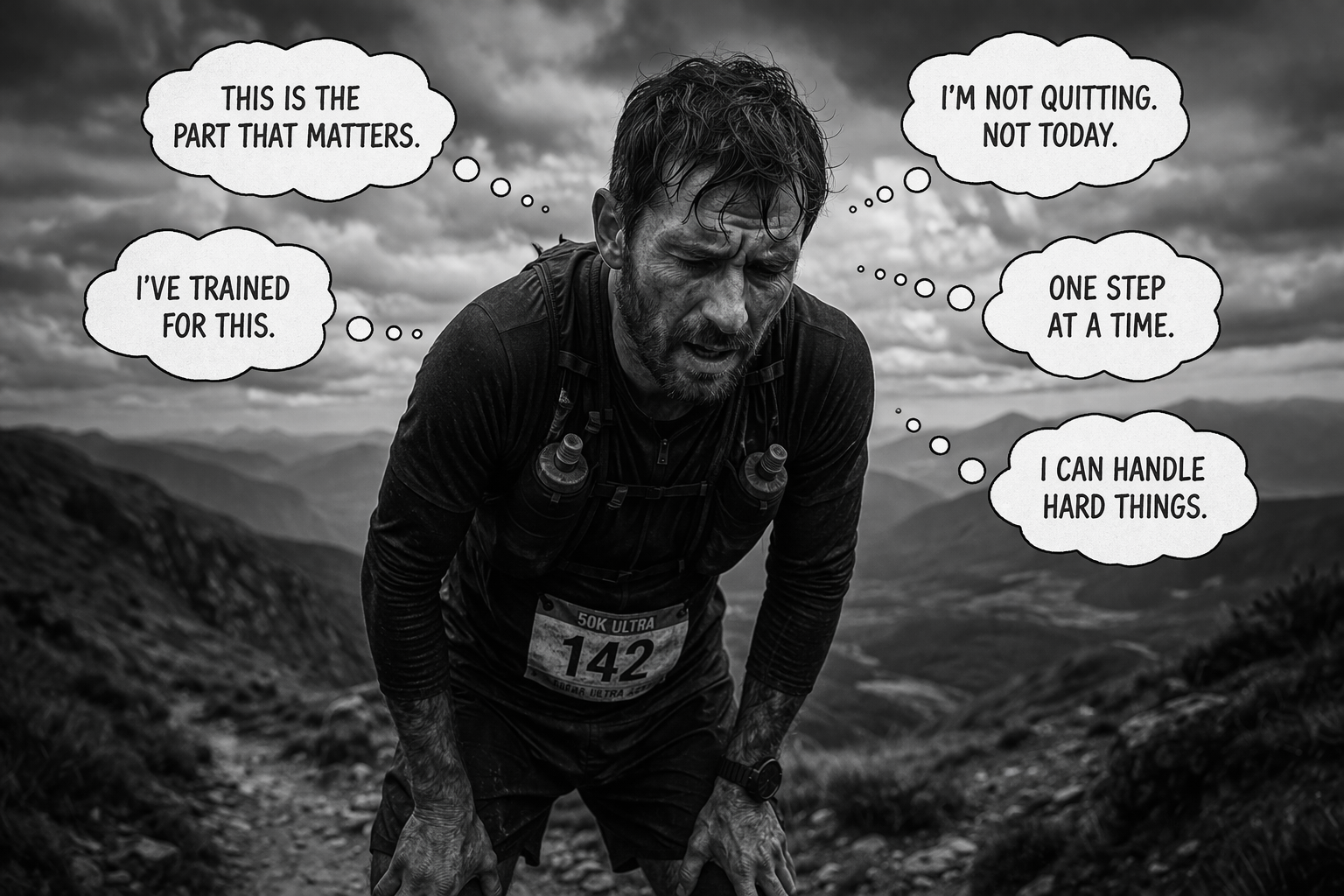
Mind games.....controlling the central governor!
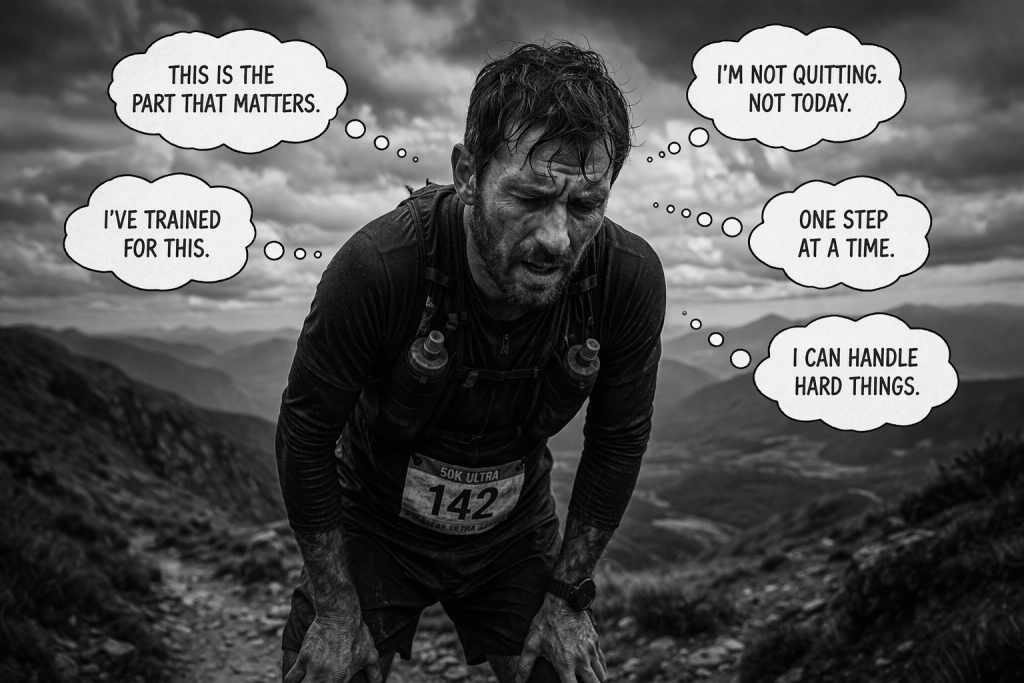
AI frames and describes this concept so much better than I ever could. I think it a useful know how to overcome the negative thoughts that mess with our minds during long or hard events. Knowing how to self-talk, accept, manage, and move forward when the dark moments are with us, is a great tool to master. Never quit a race in a bad frame of mind, clear your head, spend a few minutes having a tantrum, spend a few more minutes rationalising what's happening, then make the decision to fix forward and carry on. There is nothing worse than withdrawing from a race and later thinking you could have finished, it is a lesson we all learn, but you only want to experience it once. If you are injured or worried about your health you should always be sensible and seek medical advice or contact the race director or supporting team. Most of the time we just need to get some calories and electrolytes in, wait or walk it out, and carry on. The info below explains why our brain goes to these dark places, and ways to overcome it!
The Central Governor Theory is a concept in exercise physiology that tries to explain why fatigue happens before the body is truly physically exhausted. It’s especially discussed in endurance sports like ultra running 🏃♂️.
1. What the Central Governor Is 🧠
The idea was proposed by Timothy Noakes.
Core idea:
Your brain acts like a protective regulator (“governor”) that limits how hard your muscles work so you don’t damage your body.
Instead of fatigue being caused purely by:
- depleted muscles
- lactic acid
- glycogen depletion
…the theory suggests your brain intentionally reduces muscle output before catastrophic failure happens.
Think of it like a car with a speed limiter.
The brain constantly monitors signals such as:
- body temperature 🌡️
- oxygen levels
- glycogen stores
- hydration
- muscle damage
If it senses danger, it creates the feeling of fatigue to slow you down.
So fatigue is partly a protective illusion.
2. Why It Matters in Ultra Running 🏔️
In ultramarathons, the race often becomes more mental than physical.
Ultra runners commonly experience:
- sudden waves of fatigue
- feeling like they “hit the wall”
- pace slowing even when muscles still have energy
The central governor model suggests:
Your brain is holding energy in reserve.
Evidence for this idea includes:
End spurt phenomenon
Runners often speed up at the end of a race even after hours of fatigue.
Example:
Athletes in the Ultra-Trail du Mont-Blanc frequently finish with faster final kilometers despite extreme fatigue.
This suggests the body was capable of more all along.
3. What Actually Triggers the “Governor”
Your brain integrates many signals:
Physical signals
- low glycogen
- dehydration
- overheating
- muscle damage
Psychological signals
- perceived effort
- motivation
- competition
- mood
Fatigue is closely linked to Rate of Perceived Exertion — how hard something feels.
Two runners can have the same physiology but different perceived effort.
4. Can We “Switch It Off”? ⚠️
Not really — and that’s a good thing.
The governor prevents serious damage such as:
- heat stroke
- organ failure
- rhabdomyolysis
- cardiac events
But you can push the limits of where it activates.
Elite endurance athletes train their brains to reinterpret fatigue signals.
5. How Ultra Runners Push the Governor Back 🏃♂️
1. Experience & Exposure
Repeated long runs teach the brain that extreme effort is survivable.
This gradually raises the fatigue threshold.
2. Pacing Strategy
Going out too fast triggers the governor early.
Successful ultra runners keep effort stable so the brain doesn’t panic.
3. Mental Framing
Psychology strongly affects fatigue.
Tools include:
- chunking the race (aid station → aid station)
- self-talk
- visualization
Elite athletes often reframe pain as information rather than threat.
4. Competition Effect
Runners can suddenly access more effort when chasing someone.
This suggests the governor is context dependent.
5. Fueling the Brain
The brain monitors carbohydrate availability.
Even carbohydrate mouth rinse has been shown to improve performance because the brain detects fuel.
6. Heat Acclimation
If the brain perceives overheating risk, it slows you down.
Heat training recalibrates this signal.
6. Why Some Scientists Disagree
The central governor theory is controversial.
Critics argue fatigue is still primarily caused by:
- metabolic limits
- neuromuscular fatigue
- peripheral muscle failure
Modern thinking is more hybrid:
Fatigue likely emerges from brain + body interaction, not one single governor.
7. Ultra Running Reality 🧠➡️🏃♂️
Many elite ultra runners say the race becomes:
Managing discomfort rather than managing fitness.
The central governor concept explains why mental resilience, pacing, and experience can unlock performance even when you feel empty.
✅ Ultra takeaway:
Your body usually has more capacity than your brain initially allows — but the brain releases it cautiously.
If you want, I can also explain:
- The 3 tricks elite ultrarunners use to override the central governor late in races
- Why hallucinations happen in 100-mile races
- How the brain decides when you’re “done” during extreme endurance 🧠🏃♂️
Show me the 3 tricks
Elite ultra runners rarely “turn off” the brain’s safety system, but they trick or negotiate with it so it allows more output. Three techniques consistently show up in research and elite practice.
1. Deception & Micro-Goals (Tricking Perceived Effort) 🎯
The brain strongly regulates effort through Rate of Perceived Exertion.
If effort feels lower, the brain allows more output.
Ultra runners exploit this by shrinking the challenge.
Examples
- Run aid station to aid station, not 100 miles.
- Break climbs into 30-second pushes.
- Focus only on the next runner ahead.
This works because the brain evaluates future threat.
When the task seems smaller, the central governor relaxes its limits.
Elite athletes often use the phrase:
“Just get to the next tree.”
Your physiology doesn’t change — your brain’s risk calculation does.
2. Carbohydrate Signaling (Fuel for the Brain) 🍬
The brain closely monitors carbohydrate availability.
Even detecting carbs in the mouth can improve performance. This is why carbohydrate mouth rinse studies show increased power output without swallowing calories.
Ultra runners therefore:
- sip carbs every 10–20 minutes
- keep blood glucose stable
- use quick sugars during hard sections
Why it works:
If the brain senses energy scarcity, it tightens the governor to prevent catastrophic depletion.
But if glucose appears plentiful, the brain relaxes the limiter.
This is one reason modern ultrarunners can sustain 60–100 g carbs/hour.
3. Competition & Emotional Stimulus (Emergency Override) 🧠🔥
The central governor responds to motivation and threat signals.
When stakes rise, the brain releases additional capacity.
This is why runners often produce an “end spurt” in races like the
Ultra-Trail du Mont-Blanc.
Triggers include:
- chasing another runner
- approaching the finish
- crowd noise
- strong emotional meaning
The brain essentially recalculates:
“It’s worth the risk now.”
That’s why someone who could barely jog for 10 km can suddenly sprint the final kilometer.
Why These Work Together
The central governor constantly weighs risk vs reward.
Ultra runners influence that calculation through:SignalBrain InterpretationSmall goalsLow threatCarbohydratesEnergy availableCompetitionHigh reward
The result: more muscle recruitment is permitted.
The Interesting Ultra Runner Paradox 🏃♂️
Elite runners don’t eliminate fatigue.
They simply become very good at negotiating with it.
As Timothy Noakes described it, fatigue is less a failure of muscles and more a protective decision made by the brain.
Training teaches the brain that extreme effort is safe.