The Complete Guide to At-Home Treatment for Running Injuries (What Actually Works)
Running injuries are common, whether you’re training for your first 5K or building toward an ultra-distance goal. The good news: many minor and early-stage injuries can be managed effectively at home—if you use the right approach.
The challenge is that runners often rely too heavily on tools and overlook the fundamentals. A combination of age old methods and the new tools that are widely available on Amazon etc, can be very useful to have in your arsenal.
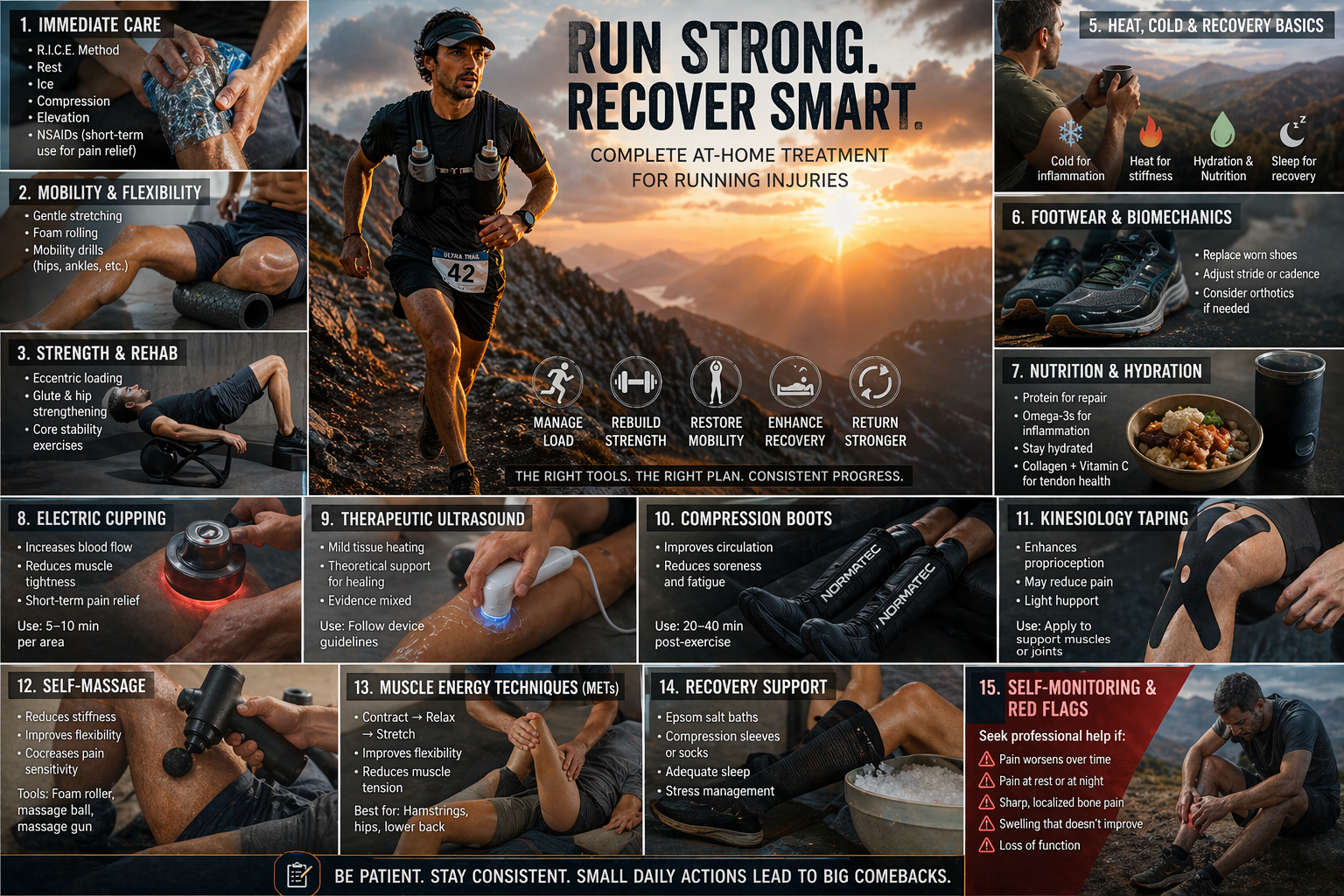
This guide combines core self-treatment strategies with modern recovery tools like electric cupping, compression boots, and kinesiology taping—so you understand not just what to use, but when and why.
The Foundation: What Actually Drives Recovery
Before exploring devices and techniques, it’s important to be clear:
No recovery tool replaces proper load management and rehab.
The most effective at-home treatment always includes:
- Adjusting or reducing running load
- Gradual return to activity
- Strength and rehabilitation exercises
- Mobility and tissue care
Everything else supports these fundamentals but seeking professional advice and treatment often informs the treatment plan. It could only be one session, but our therapists are happy to provide the nest self-treatment options and advise on how to implement them at home.
1. Immediate Care: Managing Pain and Inflammation
For acute pain, swelling, or flare-ups:
R.I.C.E. Method
- Rest – avoid aggravating activity (use it as an excuse to ignore your partner)
- Ice – 15–20 minutes every few hours (3 minutes on, 2 minutes off, 4 times is the best method)
- Compression – elastic bandage or you could use compression socks or other compression sleeves
- Elevation – injured body part above heart level
Anti-Inflammatory Support
- Short-term use of Ibuprofen or Naproxen can reduce pain and swelling
- Diclophenac or Ibuprofen topical creams (Voltorol) can be great for local treatment of soft tissue pain
Note: These help symptoms, not underlying causes. Please make sure you seek medical advice if you have not used these medications in the past.
2. Mobility and Flexibility Work
Tight, restricted tissue often contributes to injury.
Effective Methods
- Gentle stretching (pain-free range only)
- Foam rolling and massage ball work
- Dynamic mobility drills (hips, ankles)
Benefits
- Improves range of motion
- Reduces stiffness
- Prepares tissue for loading
Youtube has loads of running specific mobility sessions.
3. Strength and Rehabilitation Exercises
This is the most important—and most neglected—part of recovery.
Key Focus Areas
- Eccentric loading (e.g., calf raises for Achilles issues)
- Glute and hip strengthening
- Core stability
Why It Matters
Strength work addresses the root cause, not just symptoms.
If you drop me an email or use the contact form on the website, I will send you the running S&C PDF I give to my patients and coaching clients.
4. Activity Modification (Stay Active, Smartly)
Complete rest is rarely the best answer, I never advise my patients to stop training completely (in most cases).
Alternatives to Running
- Cycling
- Swimming
- Uphill walking
- Stair master
Goal
Maintain fitness while reducing stress on the injured area.
5. Heat, Cold, and Recovery Basics
Cold Therapy
- Best for inflammation and acute pain
Heat Therapy
- Useful for stiffness and chronic tightness
Additional Recovery Support
- Sleep (critical for tissue repair) - we need our 7-8 hours
- Hydration - ideally electrolytes in the mix
- Balanced nutrition (protein, omega-3s)
6. Footwear and Running Mechanics
Sometimes the issue isn’t the body—it’s the load being applied. A full gait analysis will help to identify asymmetry and poor running form.
Consider:
- Replacing worn-out shoes
- Adjusting cadence or stride
- Check for muscular imbalances
Small changes can significantly reduce injury risk and reduce loading. Avoiding injury re-occurrence is just as important as fixing the injury at hand.
Advanced At-Home Recovery Tools
These tools can enhance recovery—but should sit on top of the fundamentals and professional diagnosis and treatment, not replace them.
Electric Cupping Devices
Electric cupping combines suction, heat, and sometimes vibration.
Effects
- Increases blood flow
- Reduces muscle tightness
- Provides short-term pain relief
Best Use
- Post-run recovery
- Tight muscles (calves, hamstrings)
- Great for plantar fasciitis treatment
Limitations
- Minimal evidence for long-term healing, but mainly down to limited studies.
- Primarily a temporary relief tool
Therapeutic Ultrasound (Home Units)
Designed to deliver sound waves into tissue.
Effects
- Mild tissue heating
- Theoretical healing support
Research Insight
Evidence is mixed, and home devices are typically low intensity. Use for specific injuries only on the advice of a clinically trained therapist.
Verdict
Optional at best—not a core treatment.
Compression Boots
Popular among endurance athletes for recovery.
Effects
- Improves circulation
- Reduces soreness and fatigue
Best Use
- After long runs
- During heavy training blocks
Limitation
Does not treat structural injuries but does flush out the metabolic waste caused by long and intense training sessions. It is very similar to a lymphatic drainage treatment.
Kinesiology Taping
Elastic tape such as KT Tape applied to support movement.
Effects
- Enhances proprioception
- May reduce pain
- Provides light support
Common Uses
- Knee pain
- Achilles irritation
- IT band issues
Reality
Helpful, but modest impact. The outcomes are better if you get your therapist to show you how to ally it properly.
Self-Massage Techniques
Includes foam rolling, massage guns, and manual work.
Benefits
- Reduces stiffness
- Improves flexibility
- Decreases pain sensitivity
Methods
- Slow rolling
- Trigger point pressure (20–60 seconds)
Best Areas
- Calves, quads, glutes, plantar fascia
Muscle Energy Techniques (METs)
A more advanced but effective method, can sometimes get wrongly compared to PNF stretching.
How It Works
- Gentle muscle contraction
- Followed by relaxation and deeper stretch
Benefits
- Improves flexibility
- Reduces muscle tension
- Supports joint alignment
Best For
- Hamstrings, quads, pecs
- Hip imbalances
- Lower back issues
Putting It All Together: A Practical Framework
The most effective self-treatment plan looks like this
Step 1: Control Load
Reduce or modify running volume and intensity.
Step 2: Rebuild Strength
Target weak or overloaded areas with structured exercises.
Step 3: Restore Mobility
Use stretching, self-massage, and METs.
Step 4: Add Recovery Tools
Layer in:
- Compression boots
- Cupping
- Taping
Step 5: Use Optional Extras
- Ultrasound (low priority)
When Self-Treatment Isn’t Enough
At-home care has limits. Seek professional help if you experience:
- Pain that worsens over time
- Pain at rest or at night
- Sharp, localized bone pain
- No improvement after 2–3 weeks
Final Thoughts
At-home treatment can be highly effective for runners—but only when approached correctly.
The most successful runners:
- Prioritize strength and load management
- Use tools strategically, not excessively
- Stay consistent and patient
Recovery isn’t about doing more—it’s about doing what works.
References and Research
- Cheatham, S. W., et al. (2015). “The Effects of Self-Myofascial Release…” International Journal of Sports Physical Therapy.
- Schroeder, A. N., & Best, T. M. (2015). Current Sports Medicine Reports.
- Williams, S., et al. (2012). Sports Medicine.
- Wiewelhove, T., et al. (2019). Frontiers in Physiology.
- Hill, J., et al. (2014). Sports Medicine.
- Robertson, V. J., et al. (2006). Physical Therapy.
- Mourad, F., et al. (2020). Journal of Alternative and Complementary Medicine.
- Page, P. (2012). International Journal of Sports Physical Therapy.
- Markovic, G. (2015). Journal of Athletic Training.
- Nelson, N. L. (2016). Journal of Bodywork and Movement Therapies.