
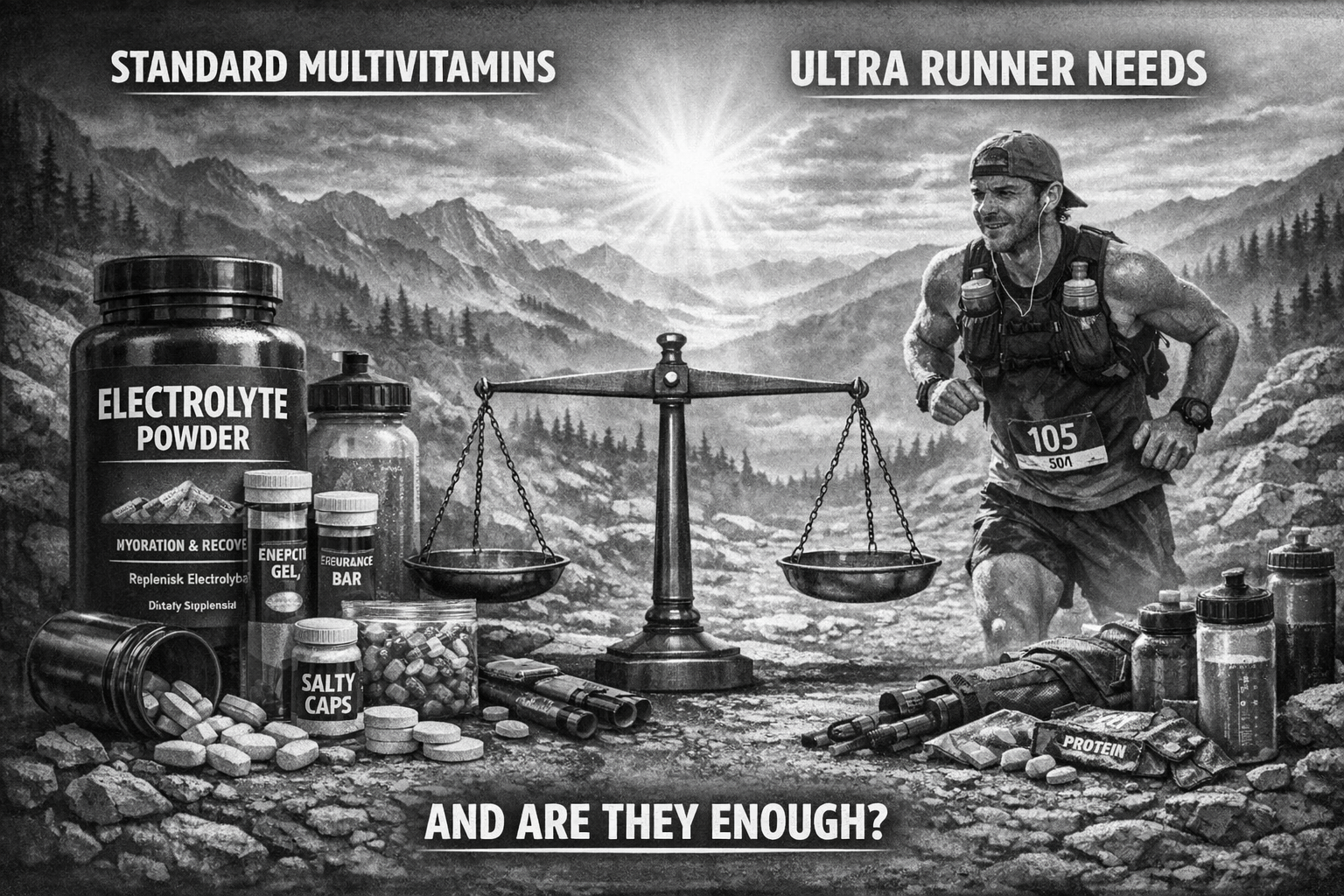
Are All Standard Multivitamins Created Equal? And Are They Enough for an Ultra Runner?
Walk into any pharmacy or browse online and you’ll find dozens—if not hundreds—of multivitamin options. They all promise roughly the same thing: “complete nutrition,” “daily support,” or “fill the gaps.” But the reality is more complicated. Not all multivitamins are created equal, and for ultra runners, the differences can actually matter.
Are All Multivitamins the Same?
At a glance, most standard multivitamins look similar—they contain a list of vitamins and minerals around recommended daily allowances (RDAs). But the similarities often stop there.
1. Ingredient Forms Matter
Not all nutrients are equally absorbable. For example:
- Magnesium oxide (cheap, common) is poorly absorbed compared to magnesium glycinate or citrate.
- Synthetic vitamin E (dl-alpha-tocopherol) is less bioavailable than natural forms (d-alpha-tocopherol).
- Folic acid is not as efficiently used by the body as methylfolate in some individuals.
Two multivitamins may list the same nutrients, but your body may absorb very different amounts.
2. Dosage Isn’t Standardized
Some multivitamins stick close to 100% of RDAs, while others provide mega doses (sometimes thousands of percent). More isn’t always better—fat-soluble vitamins like A, D, E, and K can accumulate and potentially cause harm if overconsumed.
3. Quality and Testing Vary
Higher-quality brands often:
- Use third-party testing (e.g., NSF, USP)
- Avoid contaminants (heavy metals, fillers)
- Ensure label accuracy
Lower-cost options may cut corners, leading to inconsistent potency or questionable ingredient sourcing.
4. Additives and Fillers
Binders, coatings, artificial colours, and preservatives differ widely. While often harmless, they can affect digestion or tolerability in some people.
5. Targeted Formulations
Some multivitamins are designed for:
- Age groups (children, 50+)
- Gender
- Activity level
But many “one-size-fits-all” formulas don’t account for high-performance athletes.
So, Are They Equal?
In short: no. While they may look similar on the label, differences in absorption, dosage, ingredient quality, and formulation can significantly impact effectiveness.
Is a Standard Multivitamin Enough for an Ultra Runner?
Ultra running places extreme demands on the body—far beyond what “average daily nutrition” guidelines are designed for.
1. Higher Nutrient Demands
Ultra runners often have increased needs for:
- Iron (especially in endurance athletes due to foot-strike haemolysis and sweat loss)
- Electrolytes (sodium, potassium, magnesium)
- B vitamins (for energy metabolism)
- Vitamin D (bone health, immune function)
- Antioxidants (to manage oxidative stress)
A standard multivitamin typically provides baseline coverage, not performance-level support.
2. Sweat Loss and Electrolyte Imbalance
Multivitamins are not designed to replace what’s lost in sweat. They usually contain minimal sodium and relatively small amounts of potassium and magnesium—far below what an ultra-runner loses during long efforts.
3. Energy and Recovery Needs
Ultra runners require:
- Adequate calories (carbs, fats, protein)
- Recovery nutrients (protein, amino acids)
- Timing strategies (fueling during and after runs)
A multivitamin does not address these needs at all—it’s a supplement, not a fuel source.
4. Individual Variability
Some runners may need targeted supplementation based on:
- Blood work (iron deficiency, vitamin D insufficiency)
- Diet (plant-based athletes may need B12, iron, zinc)
- Training load
A generic multivitamin cannot tailor itself to these individual requirements.
When Is a Multivitamin Useful?
For ultra-runners, a standard multivitamin can still play a role:
- Acts as a “nutritional safety net”
- Helps cover minor dietary gaps
- Supports general health during heavy training
But it should not be relied upon as the primary nutritional strategy.
What Should Ultra Runners Focus On Instead?
- Whole-food nutrition first
A balanced diet rich in:- Complex carbohydrates
- Lean proteins
- Healthy fats
- Fruits and vegetables
- Electrolyte strategy
During long runs and races - Targeted supplementation (if needed)
Based on evidence or testing:- Iron
- Vitamin D
- Magnesium
- Omega-3s
- Recovery nutrition
Protein and carbohydrates post-run
Bottom Line
Not all multivitamins are created equal—differences in formulation, absorption, and quality can significantly affect their value. For ultra-runners, a standard multivitamin can help support general health, but it is not enough to meet the unique demands of high-volume endurance training.
Think of it as insurance, not fuel—or performance enhancement.